Bedding · Fit & care
Fitted Layers for Adjustable Beds: Fit Tips for Split-King Setups
An adjustable base changes the shape of a bed in ways a flat, stationary mattress does not. In a split-king setup, two mattresses move independently, making accurate measurements, suitable pocket depth, and reliable elastic essential to keeping fitted sheets in place.
At first glance, an adjustable bed seems to ask little of a sheet. The mattress is still a mattress; the corners still need to be covered. But the moment the head rises or the foot section bends, the geometry changes. Fabric is pulled across new angles. A corner that looked secure at bedtime may loosen as the bed moves, and a fitted sheet that was already stretched tight can creep upward or pop free.
The challenge is more pronounced with a split king. Though it occupies the space of a king-size bed, this arrangement is generally made from two separately adjustable mattresses—often Twin XL—that can move independently. The bedding must fit each mattress as an individual unit. A conventional king fitted sheet spanning both sides may resist the movement, bunch across the middle, or tug against the corners.
Good fit begins before laundry day or bedtime. Measure the mattress as it is actually used, including any topper, protector, or other layer that adds height. Then check the dimensions and pocket depth of each fitted sheet, along with how its elastic is constructed. A few minutes of careful checking can prevent nightly adjustments and help the fabric and elastic last longer.
Why adjustable bases challenge fitted sheets
A fitted sheet is cut to wrap around a mattress, with elastic helping hold its corners underneath. On a flat bed, the fabric experiences relatively little change in tension. An adjustable base introduces motion: its head and foot sections lift, lower, and bend. As the support changes position, the mattress surface changes shape, too. The sheet has to move with it.
If the sheet is too shallow, its corners may be stretched to their limit even before the base moves. Raising the head or foot can increase that tension and draw the fabric off the mattress. A sheet that is too large, meanwhile, may have enough slack to wrinkle or gather, particularly where the mattress bends. Either extreme can make a bed feel less orderly and create extra work when the mattress returns to a flat position.
Material and construction matter, but they cannot compensate for a mismatch in dimensions. Softness is not the same as stretch, and a high thread count does not tell you whether a fitted sheet will grip a particular mattress. Pocket depth, elastic coverage, corner design, and accurate sizing are more direct indicators of fit.
That is why choosing bedding for adjustable beds is less about finding a universal “best sheet” and more about matching each fitted piece to the mattress and its movement. A well-fitting sheet should be secure without being forced into place, with enough ease to accommodate the bed’s range of motion.
Start with the mattress, not the label
Mattress labels offer a useful starting point, but they do not capture every detail of a finished bed. Two mattresses described as Twin XL may have different heights. One may be paired with a thick topper, a quilted protector, or both. The fitted sheet needs to cover the total depth of the surface it will actually surround—not merely the mattress alone.
Measure the mattress from the top surface to the bottom edge, including every layer that stays on the bed beneath the sheet. If a protector and topper will remain in place, measure over them. Take care not to compress a padded topper while measuring: flattening it can produce a depth estimate that is too small. For a more useful result, measure at a corner and confirm the measurement at another point.
It also helps to note the mattress’s width and length, especially when replacing a sheet or configuring an older bed. Split-king systems are commonly built from two Twin XL mattresses, but the exact equipment and bedding dimensions should be verified rather than assumed. Adjustable bases and mattress combinations vary; product names are not substitutes for a tape measure.
Record your measurements in a place you can refer to when comparing sheet specifications. For example, note the width, length, total depth with bedding layers, and whether the two sides are identical. If one mattress has a different topper or height, treat it as its own fit problem. A shared label for the bed does not guarantee identical conditions on both sides.
- Measure each mattress separately, from edge to edge.
- Include the topper and protector if they will remain beneath the fitted sheet.
- Check mattress depth at the corner without pressing down on padded layers.
- Record any differences between the left and right sides.
- Recheck measurements after changing a topper or mattress protector.
Read pocket depth as a fit measurement
Pocket depth describes how much mattress depth a fitted sheet is designed to accommodate. It is a key specification for a tall mattress or a bed with extra layers, but it is not a promise of a perfect fit by itself. A stated pocket depth should be compared with the full height of the mattress stack, and the sheet’s overall dimensions and elastic also need to suit the bed.
Consider the relationship between the sheet’s pocket and the depth you measured. If the pocket is smaller than the mattress stack, the sheet may be difficult to install or remain under excessive tension. If it is substantially deeper, the excess fabric may feel loose unless the construction gathers it securely. The aim is not to maximize pocket depth, but to find a sheet that can cover the mattress without being overstretched or left with excessive slack.
Specifications may use terms such as “deep pocket,” but that phrase can be imprecise unless a measurement is supplied. Look for a numerical depth, and check whether the maker describes a maximum mattress depth or simply gives the sheet’s pocket measurement. If the information is unclear, seek clarification before relying on a label alone.
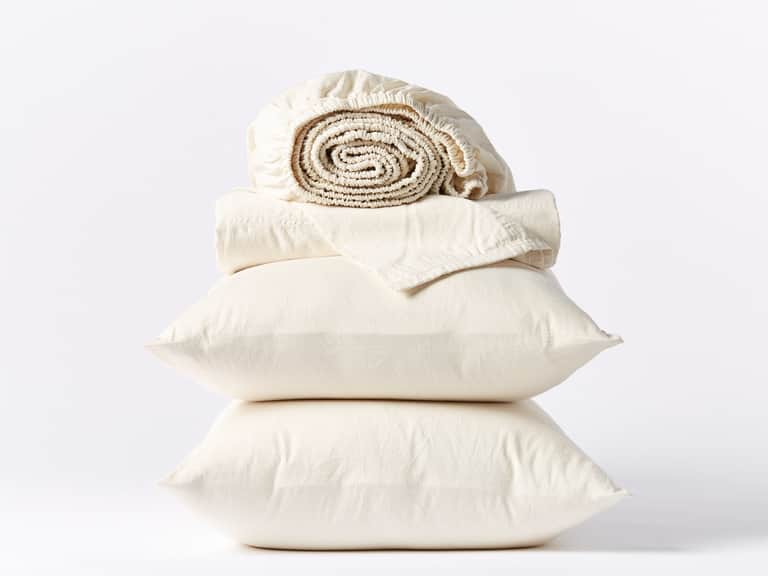
The [Organic Relaxed Linen Sheet Set](/products/organic-relaxed-linen-sheet-set-4753) lists a 15-inch-deep fitted sheet with full elastic. That gives shoppers a concrete pocket-depth figure to compare with their own mattress stack. The set’s description also identifies a fitted sheet, flat sheet, and pillowcases; for a split-king arrangement, confirm the exact sizing and included pieces for the selected configuration rather than assuming that a standard set contains two separately fitted Twin XL sheets.
More depth is not automatically better. A very deep pocket can leave extra material beneath a shallower mattress, while a snug pocket can be unsuitable for a mattress with a topper. Fit is a balance among depth, length, width, and the sheet’s ability to stay in place as the base changes position.
Elastic coverage can make the difference
Elastic helps a fitted sheet grip the underside of the mattress. Its placement and coverage influence how evenly that grip is distributed. A sheet with elastic around its entire perimeter can provide support along more of the edge than one with elastic limited to the corners, though the quality of the construction and the match between sheet and mattress remain important.
With an adjustable base, corners face repeated changes in tension. Full elastic can help the sheet hold more consistently as the mattress bends, while reinforced or well-secured corner elastic may also contribute to a stable fit. Neither feature can rescue a sheet that is too small, too shallow, or intended for a different mattress configuration. Think of elastic as one part of the fit system, not a substitute for dimensions.
When the sheet arrives, place it on the mattress with the base flat. Start by aligning the corners and making sure the seams sit squarely at the mattress corners. The elastic should hold without requiring a hard pull that strains the fabric. Smooth the surface from the center toward the sides, then check that each corner is fully tucked underneath.
Next, move the base through the positions you commonly use. Raise the head, raise the foot, and try a position with both sections raised if that is part of your routine. Watch the corners rather than judging the sheet only when the bed is flat. The goal is a secure surface that follows normal movement without pulling free or forming large folds.
If a corner loosens, return the base to flat before refitting it. Check that the sheet is correctly oriented, the mattress layers were included in the depth measurement, and the fitted piece is the right size for that mattress. Repeatedly stretching the same corner harder is unlikely to solve a mismatch and may put unnecessary strain on the elastic or seams.
A split king is two fitting problems, not one
The name “split king” can create a misleading impression: a single king sheet should be able to cover the whole bed. In a standard split-king setup, however, each side is designed to move independently. The fitted layers therefore need to accommodate the individual mattresses rather than binding them together as one large, fixed surface.
Many split-king configurations use two Twin XL mattresses, but check the dimensions of the specific components in your bed. A sheet set intended for one king mattress may include a single fitted king sheet. A split-king set may instead include two Twin XL fitted sheets, along with a shared flat sheet and pillowcases. The contents vary by manufacturer and by size, so read the list of included pieces carefully.
Compare both fitted sheets with both mattresses. If the sides have the same dimensions and depth, the same sheet specification may work for each. If one side has an added topper or a different mattress height, check whether the set can accommodate both. Two pieces with identical nominal size may still behave differently on mattresses with different thicknesses.
Also consider how the gap between the mattresses is handled. Some households prefer individual flat sheets, while others use one larger flat sheet across the bed. The flat layer is not responsible for securing the mattresses’ corners, but its size and placement can affect comfort and appearance as the two halves move. Whatever the preference, avoid using a fitted piece designed to span both mattresses when independent movement is important.
Before making a choice, check the product listing for all of the following:
- Whether the set is sold in standard king, split king, Twin XL, or another configuration.
- How many fitted sheets are included and the dimensions of each.
- The fitted sheet’s pocket depth and any stated maximum mattress height.
- Whether the set includes a shared flat sheet, individual flat sheets, or both.
- The number and size of pillowcases, which can vary with set size.
- Whether the manufacturer lists the set as compatible with adjustable bases.
Sleep and Beyond listings provide a practical example of why set contents deserve attention. One organic cotton sateen description specifies a Split King set with a flat sheet, two Twin XL fitted sheets, and two pillowcases. Another organic cotton percale listing likewise describes a Split King option with a pair of Twin XL fitted sheets. Those details illustrate the configuration to look for; always confirm the current listing, exact dimensions, pocket depth, and included components for the particular bedding you are considering.
Material affects feel, but fit comes first
Once the measurements work, material and weave help determine how a sheet feels against the skin. They shape the hand, drape, and everyday character of the fabric, but they do not change the basic requirement that a fitted piece match the mattress.
Percale is a plain weave often associated with a crisp, matte feel. Sateen uses a different weave structure and is commonly smoother and more fluid to the touch. Linen, made from flax, has its own texture and tends to soften through use and washing. These are useful distinctions for choosing a preferred surface, not rules that determine whether a sheet will stay on an adjustable bed.
Likewise, thread count should not stand in for measurements. It describes the number of threads in a defined area of fabric, but it does not tell you the dimensions of the fitted sheet, its pocket depth, or the placement of its elastic. A sheet with a desirable weave can still be the wrong choice if its fitted dimensions do not match the mattress.
For adjustable beds, prioritize a reliable specification sequence: first mattress dimensions, then total depth with added layers, then pocket depth and elastic coverage, and finally the fabric characteristics that suit your preferences. This approach keeps comfort choices in view without letting marketing shorthand obscure the practical details.
Keep the fit through washing and use
Elastic and fabric experience repeated stress from laundering and nightly movement. Care instructions are not a decorative extra: following them can help preserve the sheet’s construction over time. Wash according to the specific care label, paying attention to recommended water temperature, cycle, and drying method. Bedding descriptions may recommend different routines, so do not assume every cotton or linen sheet should be washed identically.
Avoid unnecessary heat if the care instructions call for low-temperature drying. Excessive heat can contribute to wear in fibers and elastic, while leaving sheets in a hot dryer longer than needed can add avoidable strain. If the care label advises removing the sheet promptly, doing so can also help reduce creasing. Use detergent as directed and avoid care products that are not recommended for the fabric.
After washing, check the elastic and seams from time to time. If the sheet has begun to loosen, note whether the issue is confined to one corner or appears across the entire perimeter. A single problem corner may point to orientation or repeated tension at that location; widespread slack may suggest that the elastic has aged or that the sheet never matched the mattress dimensions well.
Rotating between fitted sheets can reduce the frequency with which one set is washed and used. For households with an adjustable bed, keeping a spare fitted layer in the right individual size can also make routine laundering simpler. Store sheets fully dry and folded without pulling the elastic taut around a narrow object for long periods.
A practical fit test before relying on a new set
First, fit the sheet with the bed flat. Confirm that the corners sit in the right places and that the fabric is neither strained nor visibly loose. Check that the fitted sheet covers the full mattress depth, including the layers beneath it. If the set contains two fitted pieces, test them on their intended sides rather than treating the pair as interchangeable without checking.
Then operate the base gradually. Raise and lower the head and foot sections through the positions used in ordinary life. Look for corners that shift, fabric that pulls across the mattress, and folds that gather where the mattress bends. Return the bed to flat and smooth the sheet again. A little movement in the fabric is expected; persistent displacement or a corner that repeatedly releases deserves attention.
Finally, check the fit after the first wash. Fabric can change slightly with laundering, so follow the care label and repeat the movement test once the sheet is clean and dry. If a problem remains, compare your original measurements with the product’s published dimensions and pocket depth. That review is more useful than relying on a general description such as “deep pocket” or “adjustable-bed friendly.”
Quick checklist
- Measure each mattress and all layers beneath the fitted sheet.
- Verify length, width, and pocket depth against the product specifications.
- For split king, confirm that two appropriately sized fitted sheets are included.
- Check elastic coverage and make sure the sheet fits without excessive force.
- Test the corners while the base moves through commonly used positions.
- Follow the care label and inspect elastic and seams as the bedding ages.
Common questions about adjustable-bed sheets
Can one king fitted sheet work on a split king?
A single king fitted sheet is generally designed to cover one king mattress, not two independently moving mattresses. In a split-king arrangement, separate fitted sheets sized for each mattress allow each side to move with less resistance. Verify the bed’s actual mattress configuration and the sheet set’s contents before choosing.
How much deeper should a fitted sheet pocket be than the mattress?
There is no single allowance that works for every sheet. Compare the product’s stated pocket depth with the complete mattress stack, including a protector and topper if they remain in place. Check the maker’s guidance on maximum mattress depth as well. The sheet should fit over the stack securely without being forced or left excessively loose.
Does full-perimeter elastic guarantee that a fitted sheet will stay put?
No. Full elastic can help distribute hold around the mattress edge, but the fitted sheet must still have the correct dimensions and depth. A sheet that is too shallow or too large may shift even when elastic runs around the full perimeter. The best test is a secure fit on the flat mattress followed by a check while the base moves.
Should I measure each side of a split king separately?
Yes. Separate measurement confirms that each mattress has the expected length, width, and depth. The sides may be identical, but different toppers, protectors, or mattress models can create different fitting needs. Measuring each one prevents a shared label from masking a real difference.
Does cotton percale or sateen fit an adjustable base better?
Weave describes fabric character, not mattress compatibility. Percale and sateen can both be considered if the fitted sheet has suitable dimensions, pocket depth, and elastic construction. Choose the weave for the feel you prefer, and evaluate fit using the product specifications and a movement test.
The right fit moves with the bed
Adjustable beds make bedding part of a moving system. Every lift changes the angle of the mattress and the tension on its fitted layer; a split king adds the independent movement of two separate surfaces. Fit is therefore not a small detail hidden in a product description. It is the difference between a sheet that follows the bed and one that keeps asking to be put back.
Measure the complete mattress stack, compare those numbers with pocket depth and fitted dimensions, and inspect how the elastic is distributed. For split-king setups, confirm that each side receives a fitted sheet made for its own mattress. Then test the bedding in motion and follow its care label to protect the fit over time.
The process is straightforward, if not glamorous: measure carefully, read the specifications, and check the corners after the base moves. Those small acts of attention let the bed adjust as intended while the fitted layers stay where they belong.